


Race stats are good, but what about the rest of what makes up a serial winner like Kilian Jornet?
Winning UTMB four times is impressive, but what does Kilian think about diversity in trail? Winning Zegama 11 times is incredible, but how does Kilian reconcile all the travel he has to do? Winning Sierre-Zinal 10 times is quite the achievement, but how does co-founding an AI training app fit into his narrative? Winning Hardrock 100 with a dislocated shoulder is quite the narrative, but what are the essential things in life for us – all of us – to focus upon?
I sat down with Kilian Jornet, the greatest mountain runner of all time, to talk about all of these things, including his three-step plan to living happily.
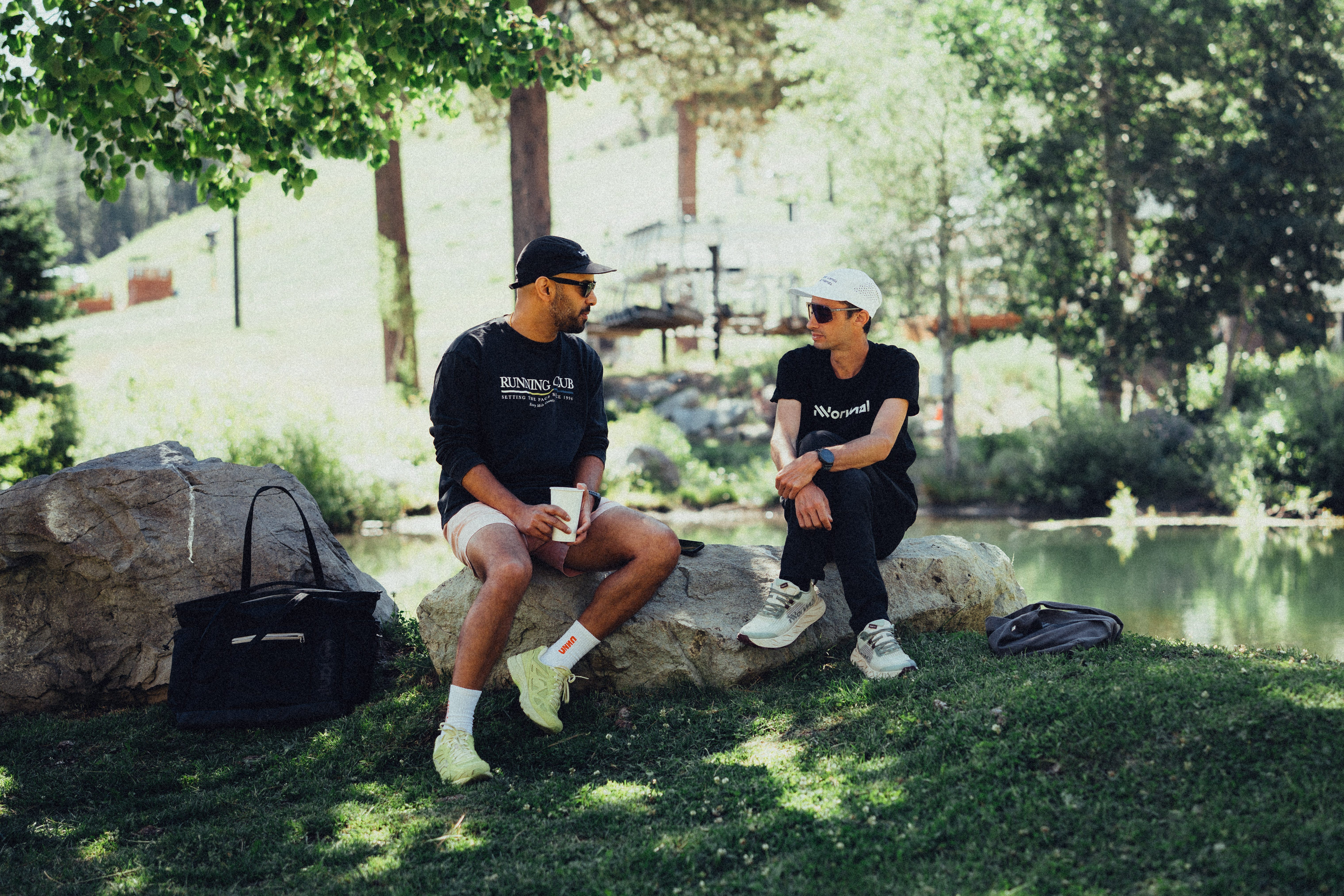
I was deeply impressed by Kilian’s willingness to engage with and ability to navigate my questions. It was a pinch-me moment of spending time with one of the greatest athletes of all time, and I hope you enjoy reading this lightly-edited transcript.
The difference between races in USA and Europe
“[At Western States], it’s 300 participants, while in Europe you have many races like Marathon Du Mont Blanc, and they have thousands of participants, and the spectators are just fans, people living there.”
“I think probably the biggest cultural difference is that towns in the US are far away from the mountains. Here, it’s like a ski resort, but it’s not a town. Nobody’s living here besides a few people. If you look at Reno, even Bishop or Boulder, they are far away from the mountain. In Europe, races pass through those [mountain] towns, so people there get more involved.”
How do you reconcile the travel required?
“That’s the biggest contradiction that I have. We have a very simple life – we have a farm – but I travel, not a lot, but I do long [journeys]. Before, I was travelling a lot, but now I will do two or three maximum per year. When I have a project or a race that requires travel, it’s something that really has a meaning. I ask if it is worth it to travel for that. That’s the red line that I put.”
“I also try to have an impact that is positive. I think as an athlete, you have a voice and you can decide who you work with as a sponsor, you can decide what kind of things you talk about on social media, and when you do interviews.”
What are your thoughts on diversity in the trail world?
“Trail running needs to do a lot of work. When it comes to sustainability, this sport is not in a bad place. There’s a lot of talk with organizers, [and] with athletes, so compared to other sports, we are in a good way, but diversity… we are in the Middle Ages.”
“It’s not very inclusive in the way that it’s pretty expensive. We need to have more local races that are cheap or free for kids. That’s something that we need to do a lot of work on.”
What other solutions are there?
“There are some things that are happening. Some organizers and cities are giving facilities, free entries, and travel to people from less developed countries, and that’s helping, but that’s for the athletes only, which brings inspiration. It’s good to have great events like Western States or UTMB that are aspirational for people to get there, but we need to have a lot of small events, and get running clubs in local races that cost $5 or are free in the cities or are close to where people live. We need to be better about organizing those things.”
Your app with Eliud Kipchoge uses AI. That will turn a lot of people off, won’t it?
“It’s to really encourage people to get out and exercise. Health is about moving mainly, and sport is the excuse that we find today to move, so to motivate people to get out to move and do it in a way that is healthy is what we’re trying to build there.”
“It just uses AI to adapt the guidelines that we give them. I have been struggling with what is the place of AI in our society in the future, and I think it’s something that will be much more used. I think it has a good implementation in many things. Some of these operations that we are doing today, AI will do much more efficiently, with less time, and we can focus on the things that are more essential.”
“Rifkin, the economist, wrote a book The Zero Marginal Cost Society (2014), and it was about there will come a time in the future where work will not be necessary. How will we spend our time? With AI, we are in that point where it’s threatening a lot of things, like how we live, but it’s not going away. So how can we use it for things that are good so we can spend more time for what’s essential for us as humans.”
“Then I think about the environmental cost of AI, but I think that’s also something that I think will drop down, just like data costs. But we need to push on lower energy consumption. In the US I don’t think it’s very good, but in Norway, it’s 99% renewable, so that we really need to push.”
What do you love about running?
“I think to explore myself. How the body changes with different kinds of training, and how you can explore your physiology or your brain when you do long adventures. It’s when I do things in the mountains that I really feel this connection with my body and the environment. The landscape, this scenery that I feel part of. I think races are very interesting to push your limits and explore what are these human capacities and how we change through different stimuli.”
How does biohacking fit into the world of trail and ultra?
“Here in the US there’s a lot of talk about biohacking [laughing]. People want quick and easy solutions, and that appeals. Take these pills in the morning, or do these exact exercises for four minutes, four times.
“The reality is much simpler than that. It’s just to have a lifestyle that is more according to who we are as a species. We are mammals. We need to move to make our mitochondria fine-tuned. Today, sport is the excuse we found to be moving. Movement is key.”
“Diet, also. Take natural food. We live in a moment that we are taking so many supplements and also foods with tens of ingredients that are more processed. Take simple food that is easier for the body to digest, that is balanced with the macro and micronutrients. And food that has bacteria. We have billions of bacteria inside us so if we eat everything super clean and processed, all this bacteria is not living there any more.”
“And then stress. It’s such a problem today, especially in places like this where there is stress about achieving. Having a lower-stress life is the most basic.”
“I have been living in Norway for 10 years, and one thing that I really appreciate there is that everybody is the same. People don’t show what they have achieved. That means that they feel good to take a job that gives you enough money to do what you really want. Socially, you can see a millionaire that has a company alongside someone who is working as a janitor, and people don’t see that one has a successful career and the other not. It’s just that he’s working as a janitor for three days and then he’s going to ski, because that’s what he likes.”
What is the best way for us to live?
“Figure out what makes you happy or what makes you motivated. Is that your job? If yes, go for it, but if it’s something else, maybe the job is something that you don’t need to keep pursuing that much. Just get the money.”
“Have more time to make that connection with other people, like family. Someone was saying that we spend so much time thinking that what’s most urgent is the most important, that we forgot the most important is the essentials. We are always thinking about the deadline. We have to think, ‘Is this thing really urgent? Is it essential for us?’”
“What’s essential? Social connection. Time for us. Time for family. Time for following what we like. That’s what is really urgent.”
Thanks for reading,
Raz xx
Buy my book, This is Running
USA - Bookshop.org US | Amazon US | Barnes & Noble | Signed copy (US)
UK - Bookshop.org UK | Amazon UK | Waterstones
Review This is Running - Goodreads
Kilian has always come across as grounded and thoughtful. If there's a contradiction in the way he operates, he's considered it and tries to square it with the way he wants to show up in the world. Good interview, thank you!