

The free radical driving gender parity on The Speed Project’s starting line
Tilly GW has challenged the gender makeup of TSP to immediate success, but there’s more work to be done. She’s doing it.

I love the word ‘radical.’ It simply means fundamental change, but what is more difficult than change. The universal truth that we know about leopards, after all, is that they cannot change their spots, and yet we persist, because submitting to a status quo that is harmful to so many is not an option for some.
The status quo in question right here is representation on the start line of races. I’ve written about this topic a number of times now (I’ll link to a few of the articles at the end), but there’s still so far to go. One of my favorite headlines, however, was when The Speed Project – maybe the most emblematic event of the past decade in the running world – introduced their Radical Equity Program.
They took the most extreme category of the 340-mile journey from Los Angeles to Las Vegas – the solo mission – and made it their goal for the field to be at least 50% women and non-binary runners.
I’ve followed the REP as they invite women-only teams to run TSP, but the content is primarily digital, in the form of Instagram posts and accounts, or YouTube documentaries. It’s inherently temporary and transient. In this era of streaming subscriptions, we don’t ever truly own digital documentation, so I find it so interesting when there’s any aspect of permanence. When athlete and artist Tilly GW quietly announced a ‘zine about the couple dozen people involved in the 2025 race, I had to know more.
Tilly has been spearheading the REP. Growing up in Cambridge, I speak to Tilly while she’s in Chile, following the Atacama edition of The Speed Project, which was created in a moment where the increasing commercialization of the LA-LV event was weighing on founder Nils Arend’s mind.
The same way that running a marathon has moved from a once-in-a-lifetime bucket event to something amateurs are trying to do six times in a year, TSP is part of a marketing plan now. Run club founders are talking on Linkedin about having four teams running it, sponsored by X brand. There are dedicated storytellers on each team. They’re running across difficult terrain, sure, but primarily they’re creating that kind of temporary (dare I say forgettable, if not disposable) content that I referenced before.
It’s all inspired by the can’t-be-beaten video documentation of the first sojourn across the desert, but it goes against the spirit in which The Speed Project was founded. Trying to sell a pair of shoes isn’t that radical. Once Nils accepted that his brainchild was a whole different beast, he decided to use the splinter events to fulfil his punk rock desires of building a race that nobody can run. The Atacama Desert is fabled for its harshness.
I’ve spoken to too many stakeholders in the American ultra-running world who bristle at the idea of being associated with The Speed Project. TSP, with its ‘radical’ ideas, is seen as an outsider. I see The Speed Project as a prescient bellwether in the world of running. The Radical Equity Program is the next big part of that, and Tilly was instrumental in making it happen.
“I made clear that everything I’m working on, I’m going to bring this conversation around equity and who we’re seeing and who we’re listening to.”
I already told you about where Tilly came from and where she is now, but in the middle, she joined the school track team (“as an outlet for my rage.”) Through those track meets, she saw a bigger world. She also noticed more and different iniquities of life as a result. We joke about calling her a ‘free radical’ because of her degree in Chemistry, but those reactive atoms are essential for life.
Tilly and I met last summer at my London panel about women in running, where there was a flashpoint moment where we all asked, “Where are the men??” Today, we’re talking about reading bell hooks and Foucault, and how these decades-old ideas are still so relevant (and necessary) today. If you’ve monitored the reaction to the new Louis Theroux documentary on Netflix about the Manosphere, you’ll understand what a unique and somewhat terrifying position we’re in right now. The kind of position that demands action.
Immediately upon Tilly joining the TSP team, Nils set her to work with New Yorker, Malcolm Ebanks, who had completed TSP: SOLO himself and understood the race. They came up with the Radical Equity Program, and held workshops and one-to-ones over eight months, building, talking, responding to the world and each other, matching it all with the practical considerations of running 300 miles from LA to Vegas.
“The assumption was that we’d be turning men away. That was the thing, but we made just one public announcement about the 50% commitment, and hosted one open call to share information and hear from past solo runners, and what happened is that we actually received more applications from women than men for the race itself.”
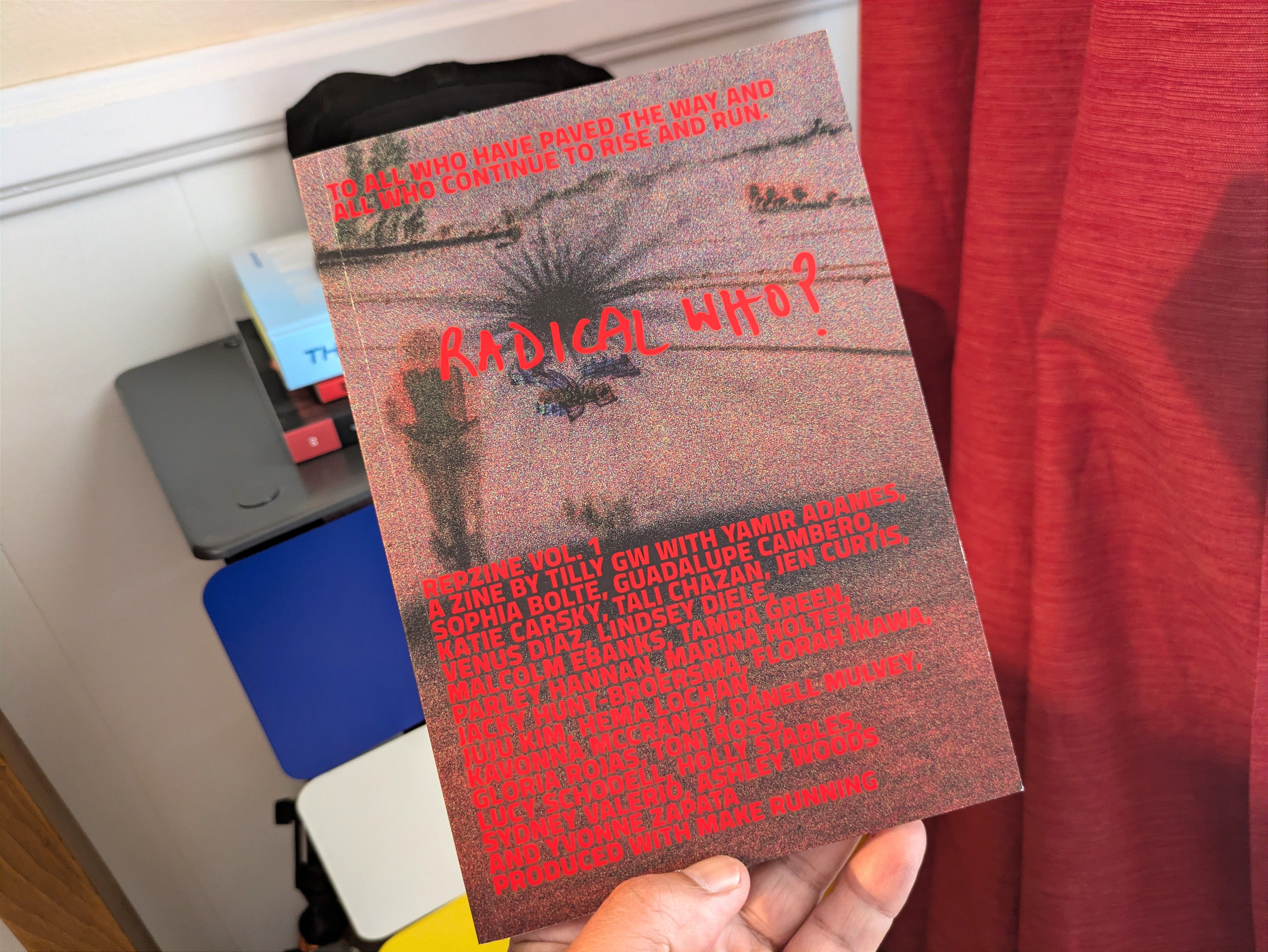
This zine, titled ‘RADICAL WHO?’ is a beautifully intimate documentation of what went into those running TSP as part of the Radical Equity Program. All the laughter and the gritted teeth is encapsulated in recollections, personal anecdotes, explanations, and a slew of glorious photos. It’s a permanent documentation of an important moment. The successful results of an established organization’s bold encouragement to an unjust world deserve to be recorded.
“It’s not that these runners are not existing, or that they don’t have the aspiration is what we really took away from that.”
For me, that’s key. It’s one thing to take the space for yourself as a marginalized part of society, but TSP is the perfect example of why it’s incumbent on organizers to understand enough to make the space. Broken Arrow Skyrace continues to do it, and a tiny handful of other races demand gender parity. Social equity is still a radical concept to too many.
“This is not a revolutionary, crazy, offensive suggestion that we just have the same opportunity. It’s in part rooted in the idea that in order for one person to come up, someone else has to go down.”
The evidence is in the year-on-year growth in participation of The Speed Project. Sure, just like every race on the planet, more people than ever want to run the big race, but absolutely nobody’s missing out here. Quite the opposite, in fact. Take note.
What’s next for Tilly? She’s taking on the mountain races of Europe with The Mathieu Project, an eight-month program offering coaching and resources to women and non-binary runners to run an ultra in the Alps in summer 2026.
It’s another tongue-in-cheek name that came from finding out that the number of men named Mathieu running a race had increased 125% year-on-year, while the number of women participating had increased just 6%. I wouldn’t bet against Tilly fixing that as well.
The Speed Project features a lot in my book, This is Running, which is released in less that two weeks in the UK and the following week in the US. Please pre-order it if you haven’t yet!
USA - Amazon US | Bookshop US | Barnes & Noble
UK - Amazon UK | Bookshop UK | Waterstones
Canada - Amazon CA | Indigo
Links & further reading


Thanks for reading
Raz x