


U is for UTMB, of course
I spent the last week in Chamonix in the French Alps. I was experiencing the glory of the Ultra Trail du Mont Blanc for the first time, and it truly was glorious.
Everything from spotting the white peak of Mont Blanc appearing through an alleyway or across a vista as I turned a corner to the food to seeing the first non-white winner of UTMB since the very first edition on Saturday afternoon.
All week, Ben Dhiman winning the 100-mile event was top of my conversation of what I hoped to happen. A man with heritage from the Indian subcontinent winning the most prestigious race on the trail calendar? Yes. Please.
And then he did it. What a moment it was seeing him cross the finish line at 2:04pm on Saturday. Just like Rachel Entrekin winning Cocodona, however, it doesn’t mean we’ve solved everything. It doesn’t mean we’ve solved anything.
After 48 hours of social posts and news stories about Ben Dhiman winning UTMB, is anyone other than me celebrating the biggest race in the trail-ultra calendar being won by a man of South Asian heritage? I haven’t seen any. If you have, please tell me because I want to be friends with them.
A huge part of that is that I haven’t actually seen Ben discuss his heritage in interviews. He’s widely celebrated as a boy from Cincinnati who moved to France with his wife and got this deep into mountain running partly due to French employment laws leaving him redundant for two years.
Maybe that lack of discussion comes from a lack of interest or knowledge from the interviewers, but it might also come from within. Maybe Ben simply wants to be known as the winner of UTMB. Maybe as an American. Maybe as an Ohioan. Primarily as the man who finished running around Mont Blanc 81 minutes faster than anyone else ever has. 7% faster? Crazy fast.
As a boy from northeast London, I primarily used to fall asleep dreaming of scoring last-minute winners for current Premier League champions Arsenal. Helping my parents’ home nation qualify for the World Cup wasn’t my priority, even though I knew that would be cool.
In the same way, South Asian representation in running wasn’t always a focus for me. I used to just run a lot. Sure, I was the only Bangladeshi at run club 99.9% of the time, but I wasn’t really thinking about it because there were plenty of other immigrant kids. More recently, I’ve been somewhat radicalized by seeing how the running industry sausage is made (and who exactly makes it).
Searching for someone, anyone who looks like me Western States, The Running Event, TrailCon, and, most recently, the Global Majority Meet-Up in Chamonix has kept flipping the same switch for me. And I’ve been party to increasing numbers of conversations to know that I’m not alone in that.
I would love to primarily be known as the Substack guy who wrote a running book, and that people enjoyed the book, and that the book was even good enough to be stocked by the best department store in the world. That stuff doesn’t put people off as much as being the guy relentlessly writing about getting more South Asian representation in the running world.
Personally, I love it when other people are organizing something that I can join in with. For example, there was a Global Majority Meet-Up1 organized by Sabrina Pace-Humphreys who founded the UK charity, Black Trail Runners2. It’s so great that UTMB made space for such a wonderful event.
I wrote about the Black experience in Chamonix back in March 2025, so I knew that this gathering was an excellent opportunity to push the conversation along. However, upon arriving, I found that I really didn’t see myself among the 100 or so attendees. A similar sentiment to Sabrina’s in her film, We Are Here3.
Take a moment to consider how many South Asian-origin athletes represent the British or American Olympic teams. In 2026, I really, really should not be one of the very first South Asian authors of a running book. I want there to be 100 more so it ceases to even be something to mention.
In my book, I outline the inexorable rise of ultramarathoning in China, and there was a huge, visible East Asian contingent in Chamonix for all of UTMB week, so I was surprised to see even fewer people from that section of the Global Majority at the meet-up.
When I pointed out on IG that I felt like a statistical minority even at a Global Majority Meet-Up, I received a few slightly defensive responses reminiscent of when I’ve highlighted the incredibly white demographic stats in trail running. Yes, there may have been another couple of South Asian people at the meetup, but I would maintain my position that 3% rather than 1% is far from a success in representation of South Asian people, who make up 30% of the Global Majority.
For clarity, I’d have liked 30% of the Global Majority Meet-Up at UTMB to be South Asian, not 3%. I’m certain you would like that as well.
I care much more about working together to achieve that success in parity. My dream would be to be actively invited to something like that. Having a sign-up link is a great middle ground of being able to say it was open to everybody, but I believe directly inviting people to a party is the best practice, and the onus is on the most powerful: UTMB.
One method – and maybe they did do this (which makes the situation worse) – if UTMB invited the gazillions of brands in attendance to send someone to the event, it would be a great start. If the brand doesn’t employ anyone from the Global Majority or simply doesn’t care, that says a lot. Word will spread one way or the other.
For me, a large issue is that I don’t really believe that intersectionality exists. And if that makes you bristle: good. I want it to change.
Some believe that a lot of the big names who rise to the top of campaigning for diversity, equity, and inclusion are largely out to make a name (and money) for themselves. I have a slightly kinder view where many really only think about uplifting others who are exactly like themselves.
When I see how women and Black people have climbed the closest, but still haven’t achieved anything approaching true equity despite the years of constant campaigning, I know that my kinfolk are far behind. It’s one of the reasons why I write about those topics so frequently. I see us all as having the same fight, and I don’t want any of us to be behind. Regardless, reciprocation and unity among allies pulling for the same thing – intersectionally or as part of a Global Majority – would be magnificent and helpful, but feels at least a half-step away.
Like I said: this win doesn’t mean that we’ve solved anything, but I’d love to see more progress next year. Maybe Ben Dhiman’s record-breaking effort can be the next catalyst.
Thank you, HOKA
Eternal thanks to Hoka for getting me on that finish line VIP platform to see that historic moment. What a view.
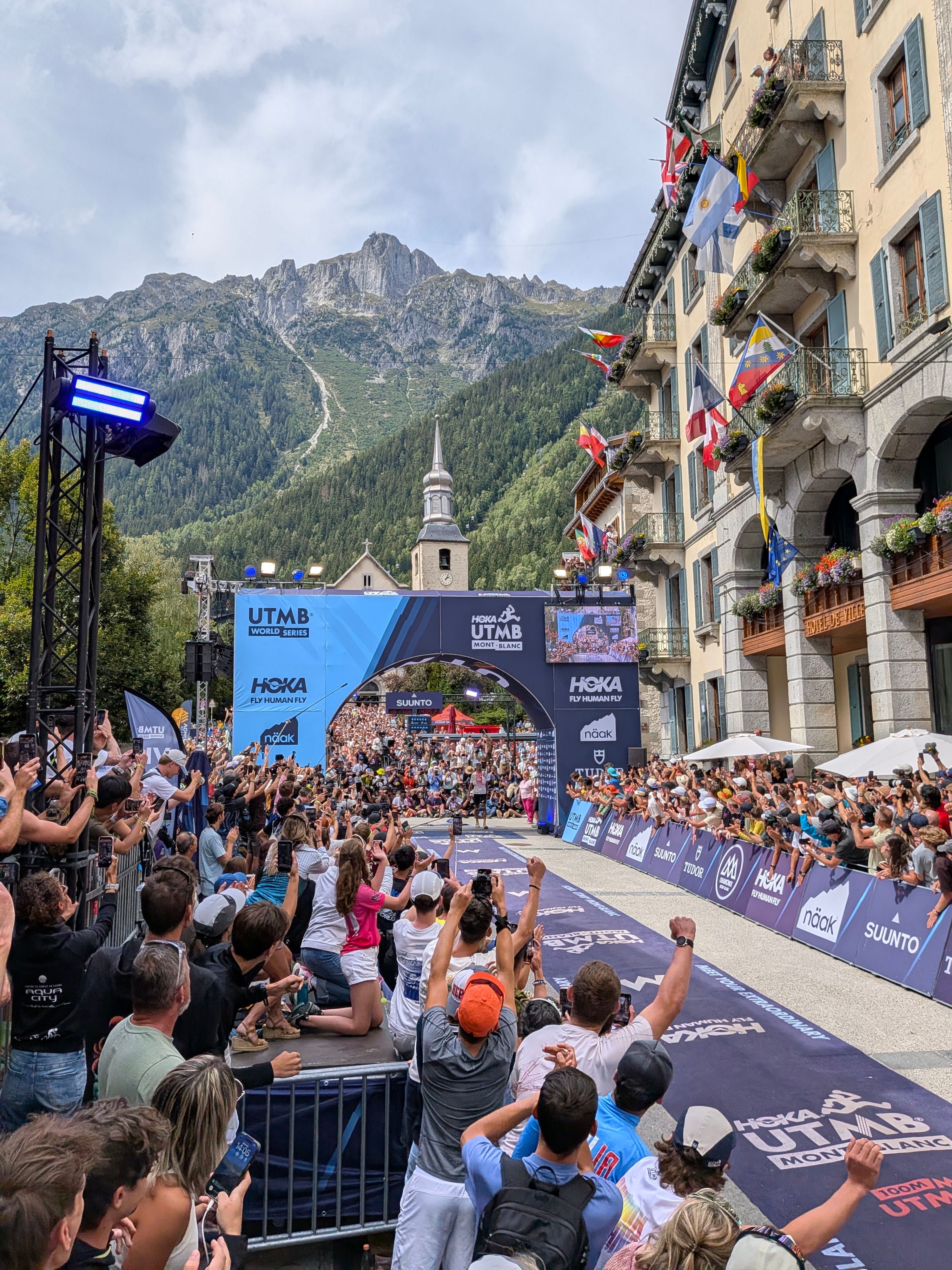
Chamonix was taken over by UTMB and its title sponsor, Hoka. With the influx of 100,000 visitors, I fully understand the Mayor’s promise to make it better for residents. It’s a local race that’s been commercialized and co-opted by the world.
Hoka in particular had their bright blue, yellow, and orange fingerprints on seemingly every part of the city. From a brand strategy perspective (one that I love), it was a masterpiece. Read this from PEOPLE BRANDS AND THINGS for an excellent rundown. Did I see some of the photos in this article being taken? Yes, I did.

The common feature of the best brand activations in Chamonix
As I mentioned, Chamonix was 100% Hoka-town last week, but four other brands managed to stick out to me, and they all had one thing in common.
First, there was the rabbit Clubhouse with Halo, with its slap bang centre ville location and carefully-curated programming, it was a dream to host a book event there. Thanks so much to the readers who came down! It was so lovely to meet you.
