


I like to highlight when people do good using the art of running. The efforts during the Los Angeles wildfires by Silver Lake Track Club, who raised over $50,000 for various charities by organizing a race from Altadena to Malibu, and Koreatown Run Club who set up a whole warehouse assembly line for immediate relief, for instance. The founder of Eagle Rock Run Club ran a marathon around a quarter-mile block of Northeast L.A. this past Independence Day to raise money for immigrant rights at a dystopian time when the American military has set up shop in one of their own cities.
But what about those for whom it’s not a one-off? What about those who alter their entire lives so they might change someone else’s? Leslie Gold is one of those people who is using running as a tool. She is supporting long term sobriety with her Los Angeles-based non-profit organization, Strides in Recovery.
Founded in 2018 with a goal of coaching newly sober individuals in Los Angeles County addiction treatment programs to complete running events from 5Ks to full marathons. It’s based on the idea of providing the structure of a real support network so that people can focus on doing the really hard work of recovery.
Addiction is not a rarity, to be clear. Estimated to affect 1 in 3 American Families, half of those who complete treatment programs relapse within a year – something that exasperated Judge Craig Mitchell when I spoke to him about the work that Skid Row Running Club does. The formal medical system that’s in place is not broad or thorough enough to help people to fully recover, so organizations like these two are essential augmentations.
So how did Strides in Recovery start? A lifelong runner, Leslie was encouraged by friends to run her first marathon back in 2012. Aged 51, at the time, she realized that to work that hard for something, she needed a very strong reason, so she decided to run for a good cause, but had no idea what that good cause would be. When she saw an advert to “run to save a soul,” from the only Jewish charity team at the L.A. Marathon, she naturally gravitated to them due to her faith.
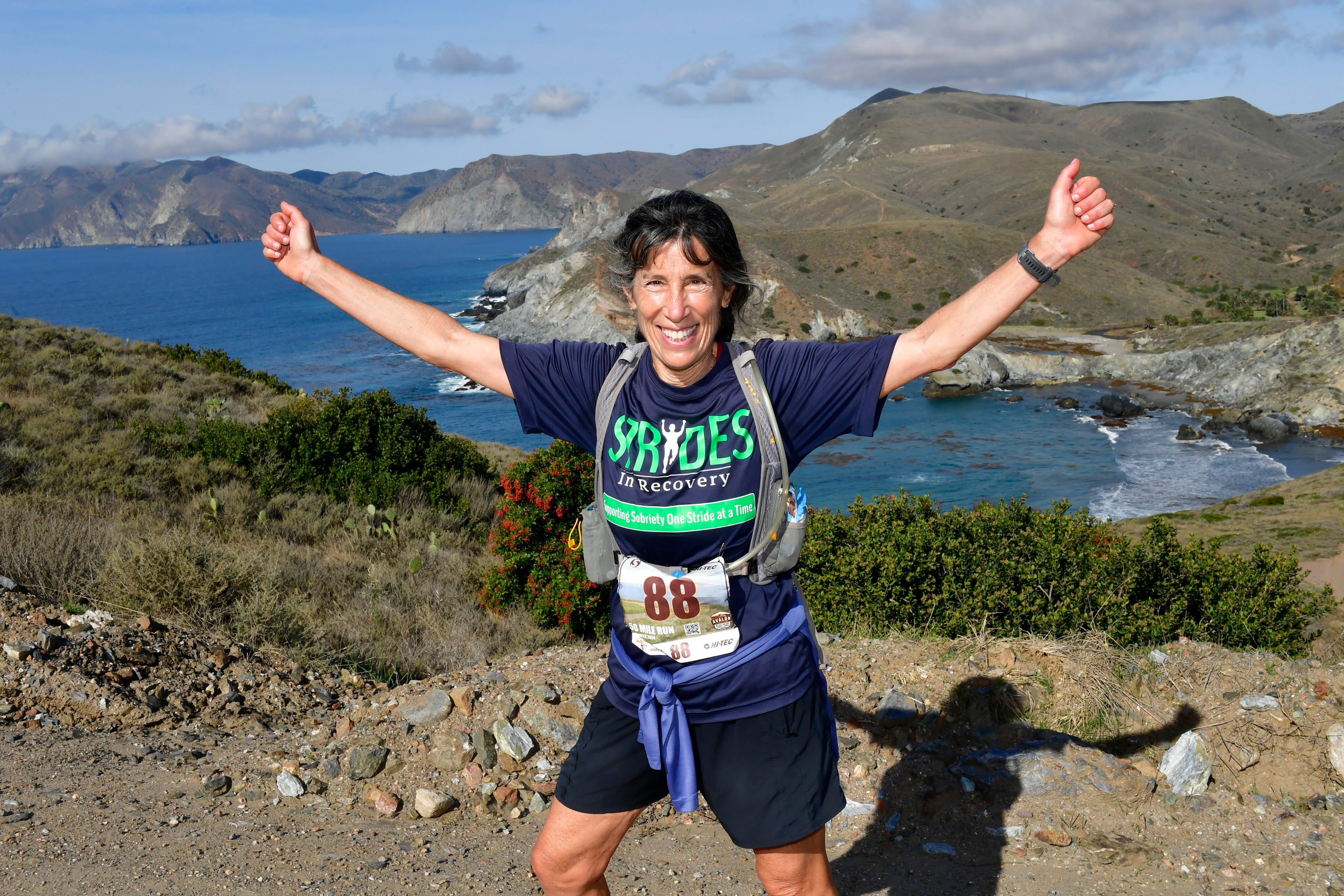
She duly attended the first meeting, and while listening to her fellow runners’ stories, realized she had inadvertently joined an addiction treatment program. Back then, Leslie knew little about addiction (“It wasn’t talked about the way that it is now.”). So, when it was her turn, she said she just wanted to run for a good cause, and she got a round of applause. She was stunned, and continued to learn as they trained for the race as a group.
“I was so worried that they weren’t going to accept me, but people were so warm and welcoming.”
“I would be running with people, and I’d be helping them out with running tips because I had done a ton of half marathons at that point, and they would be sharing their stories with me. If you’re running 15 miles with somebody, you’re tired and you’re never looking them in the eye because they’re at your side. People shared all kinds of stuff, and at the end they’d always say thanks for listening.”
I’ve written about the intimacy of running before, and this point about not having to look your partner in the eye sparking an increased level of vulnerability is really interesting. It reminds me of the Sacrament of Reconciliation AKA going to Catholic confession, where you sit anonymously in a booth and recant your most recent wrongdoings to a priest who almost certainly knows who you are. That lack of eye contact is crucial to opening the floodgates of conversation.
It was Beit T'Shuvah in West LA (translation from Hebrew: house of repentance) where Leslie found the training group. After seeing how much she helped the community, they asked her to coach the team the next year, and she has done ever since. It was from hearing more and more stories about how running taught people they had more strength and resilience than they ever would’ve thought that Leslie thought that every treatment program should have a running program. Eventually, she realized it had to be a full-time job if she was going to make a real difference in people’s lives, so she retired from her career in healthcare consulting and made the leap.
Seven years later, Strides in Recovery services 22 separate residential addiction treatment programs across L.A. County, and 1,300 people a year go through the program making it the nation’s largest sober running/walking program.
That it’s a walking group is important messaging to make explicit. This makes Strides in Recovery as accessible as possible to people who might be at an all-time low for confidence in themselves and their health. This is reflected in their coaching program, which is made up of former program members who have returned as volunteers so they can help people do everything from getting out of their residential facility for a walk to those looking to race marathons.
Leslie brings all the programs together a couple of times a year, running from Hermosa Beach in LA’s South Bay to an AA meeting. That local aspect to the organization is important when it comes to showing up at races around the city.
“It was a deliberate decision to keep it in LA County because we felt that community was such an important part of it. The running community knows who we are, and for people who may be struggling, they’re seeing this message that recovery is possible.”
There is the added layer of comfort for those program members who relapse. If they find themselves in a different facility that also has Strides in Recovery as an option, it gives them a familiar option for their next good decision.
I’m in a very different phase of life to when I was scooting around London between gigs and parties in my 20s during my music journalist days. As I’ve spent increasing amounts of time in and around different parts of the running world over the last couple of years, the more sober people I have come across. So many of my old friends from the entertainment world are now in active recovery after years of abusing various substances.
If you’ve been reading for a while, you may recall the story of the moment that I realized that I couldn’t be one of them. It was 5:31pm on a spring evening when I was being beckoned by radio station colleagues towards another inevitably long night on the lagers when the penny dropped that I actually valued a healthier body and mind over the promise of another evening of post-work drunken adventure. That was the moment when I made the good decision to find balance by running regularly as an adult.
If you’ve already fallen into the clutches of addiction, however, those good decisions aren’t as easy to make. Leslie talks of imaging studies showing how the brain of someone prone to addiction lights up with activity far more than someone without those issues in their life. Her advice?
“Get addicted to running!”
As we discuss the euphoria of the Runner’s High sending endocannabinoids coursing through your body, Leslie tells a story of a program client who she knew had it in him to run, but she couldn’t find the right motivation.
“Finally I said that if he runs, he gets some free weed. He said he’s not allowed to touch that stuff.”
When she explained how the human body creates the THC-like substance in your body after a short while, he tried it. Endocannabinoids affect the body in ways that those suffering from addiction may struggle to do otherwise: pain and sleep, inflammation, metabolism, pain relief, and more. It’s truly fascinating how many bodily processes endocannabinoids impact. She didn’t go into even that much detail, but it worked.
“He came back to the group and said, ‘Guys, you gotta run. It’s like getting half loaded!’ It’s much more believable coming out of his mouth than mine.”
Leslie’s advice if you don’t know where to go for help?
“Reach out to somebody that you trust that understands and will support you, because it’s not going to get better on its own. 90-95% of people who need help won’t seek it. I think it’s hard for people to admit they can’t fix it themselves. Drop into an AA meeting and you’re going to find a really supportive community. There’s a ton of free help out there but just don’t give up.”
Many of the programs that Strides in Recovery works with are funded by Medi-Cal, California’s healthcare system for low-income individuals. Even in the face of new proposed federal cuts and work stipulations, which could take healthcare away from up to 8 million Californians, it’s important to remember that these organizations have always worked within the system that we are afforded by the government. No matter how difficult life is made for those who need help the most, there will always be gems in our community like Leslie Gold.
Links
Further reading


Housekeeping
UPGRADE - Upgrade your subscription for just $1 a week if you are able.
BUY ME A COFFEE - Think of it as a tip jar for my writing.
SHARE - If you enjoyed reading this, or found it helpful, please share it.
WIN - Upgraded subscribers can win a $100 Janji gift card every single week of 2025. July’s entries are open!
MERCH - You should get a Crying & Running t-shirt from Running Wylder.
GET FREE STICKERS - Get 5 Running Sucks stickers for FREE. Maybe in conjunction with the tip jar…
CONNECT WITH ME - Instagram / Strava
Thanks for reading
Raz x
I've been volunteering with Strides for a couple of years now. Leslie is genuinely caring and approachable. The program is amazing. The guys I coached have made huge improvements on time and discipline. The program works
lovely piece Raz. Thank you 🙏