


Stories are important.
Here’s a quick one: Last night, I watched a short video clip of ICE, the USA’s secret police, shooting a 21-year-old man in Santa Ana, California in the eye before dragging him away along the concrete. He will never see out of his left eye again.
I wrote about Keep Runnin’ Santa Ana and the prominence of ICE in that part of California in my first article of 2025.
I have a theory that the world has always been on the knife edge of fascism, but positioning the Nazis (the fascists, for clarity) as the bad guys who lost World War 2 has been our saving grace, tipping the balance when directing young minds away from their autocratic tendencies.
WW2 ended over 80 years ago in September 1945 and many of the people who told kids those stories (grandparents with first-hand experience of war) are no longer with us. History class is great, necessary even, but we know that even the best students don’t really pay attention to textbooks as much as they do to granny spinning a yarn about how grandpa went and vanquished the Germans (note how that narrative appeals to xenophobes as well).
Those tales paint a picture of good guys and bad guys, like a Clint Eastwood classic, even if the reality of global geopolitics is infinitely more complex. A large, vocal and visible portion of the United States wanted to support and fight for the other side in WW2, for instance. The narrative of winning, on the same side as the good guys has made that uncomfortable truth fall into the shadows much more easily. Stories are important.
Over on LinkedIn, capital-S Storytelling is the latest hiring fad in how companies are marketing their wares. It’s a business strategy. Telling stories about running is what I’ve been doing here for the past three years, but I’ve been doing it elsewhere about musicians, movie franchises, and then various corporate entities for a full quarter-century, so I’m fully onboard with the ChatGPT-generated bullet points that unemployed marketing consultants are getting hundreds of lightbulb reactions for over there.
In the running world, for instance, it’s the reason you give yourself for caring about your Bandits (sci-fi cool) or your Nikes (heritage cool), your Satisfies (renegade cool) or your World Marathon Majors (gotta collect ‘em all). It’s all narrative. It’s all world-building. It’s all storytelling. It’s something to belong to.
One of the strategies that running brands use to position themselves as got-to-own items is the humble influencer. By partnering with these intensely popular online figures, who share their lives in shortform videos on TikTok and Instagram, a little bit of that popularity rubs off onto their brand. It’s the power of endorsement, and it’s all woven into the fabric of the larger narratives owning the conversation. How do the brand’s values align with this individual’s? And can you identify with that? Yes? Buy this product, then.
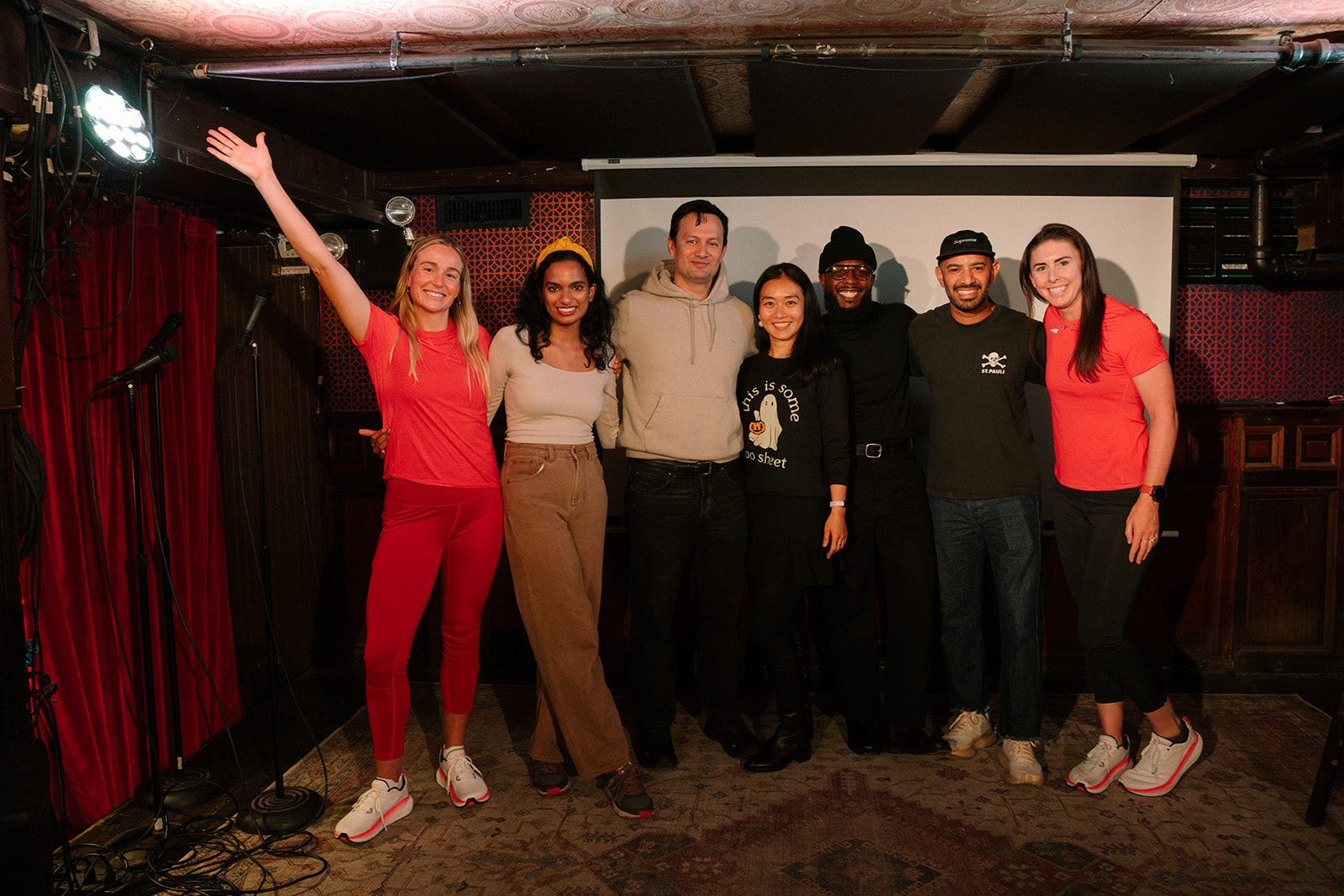
I sat down with Lydia Keating a few weeks ago to talk about her life as a running influencer and her burgeoning run club, goodstory.
A competitive rower at college, Lydia was burnt out by the end of that chapter of her life. When she moved to Los Angeles in 2017 to forge a career as a television writer, she found it easy to denounce the athletic side of herself.
“At the time, I felt like I had to choose either being the jock or the artsy creative person, so I didn’t work out for a couple of months but then I was like, ‘Wait now I have mental health issues.’”
So she started running. Lydia was still fit enough from college to immediately complete a trail marathon in SF, which set her off on a decade of running a marathon every year, “but always for the vibes, always at party pace, because I loved the feeling of movement.”
In LA, Lydia was doing stand-up, getting comfortable telling stories onstage. When the pandemic hit, she downloaded TikTok and started using that as a way of sharing her comedy online. A year in, having not been onstage for that whole time, Lydia started to question if that was even something she wanted to do any more, but she’d been running the whole time. So she started sharing her running. And her notifications started blowing up.
“I think people found the idea that you could move your body just for fun, to feel good, for mental health reasons, was novel at the time. One of my most viral videos was, ‘Come for a 15 mile run with me.’ I think the idea of putting on a fun outfit and doing that for two hours – just for fun – people were like, ‘You can do that??’ I think the casualness that I approached running with felt approachable to a lot of people.”
The approachability is an important point. An overwhelming proportion of this new cohort of runners since 2020 are women, and running isn’t always the most approachable sport. Sure, brands like Lululemon, Athleta, and Oiselle making high-quality running apparel for women have been a huge part of it, but influencers like Emily Shane and Celina Stephenson, who I wrote about in 2023 have been massive trailblazers in getting young women to believe that they even can.
Seeing these people running marathons that they either never thought they could, or running them in a way that looks genuinely fun is why the London Marathon had over a million entries for the 2026 edition. The stories that influencers tell can change the idea of running a marathon from being aspirational to being something that’s possible. As a lifelong runner, all I want is for more people to experience how cool running is.
One of the very coolest parts of modern running is how many different options there are. Yes, you can run a marathon once a month, or you can run a marathon never. You can find a run club of people who look like you, or you can find a run club where your standard three-mile run ends at a bar where you can choose to stand up and tell a story to your fellow runners. That’s goodstory, Lydia’s Brooklyn-based run club, which is wholly indicative of her personality.
“It’s me figuring out how I blend these two parts of me that I love and want to coexist.
Once I’m at a certain level of fitness, where running becomes less of a chore, I find that running is the most beautifully creative moment of my day. It’s linked to the flow state, where you can drift off into a mindful meditation, quietly untangling all your thoughts into something more cohesive. Brendan Leonard quite poetically framed running as your own personal cabin in the woods. Appropriate that a powerhouse creative can come up with such a turn of phrase.
Lydia has plans for building out goodstory, as well. Right now it’s just the monthly run club, but she’s also placed a writing workshop under the umbrella, and wants to create a physical quarterly magazine. It’s ambitious, but it’s what she wants to spend her time on, even if none of it’s making money just yet.
“I should think about how I make money from it, she laughs. “There’s something about that that feels antithetical to what goodstory is, which is people moving their bodies together and then sharing beautiful, vulnerable, funny, weird stories together.”
If you’re in Los Angeles at 8.30am on Sunday 18 January, join the LA chapter of goodstory. You can run 3.1 miles through West Hollywood and then share a beautiful, vulnerable, funny, weird story about RISK with me and Lydia at the Salomon store. We’ve got food and drink for after the run, and we’re going to have some fun.
Links and further reading


Thanks for reading
Raz x
Instagram